


You’re in early. Staying late. Putting in the extra reps. And you’re still stuck in the same place you were three months ago and not seeing any real cheerleading skill progression. If that sounds like you, this isn’t an effort problem. It’s a foundation problem.
And until you fix the foundation, no amount of additional work is going to get you where you want to go.
The Real Reason You’re Stalling Out in Cheerleading Skill Progression
Here’s what I see all the time. An athlete who genuinely cares. Who’s putting in the time. Who has the drive. And who is still coming up short of where they think they should be. The instinct in that moment is to work harder. Add more reps. Stay later. But all that extra effort without direction is going to do one of two things to you, and both of them suck.
It’s either going to stall your progress, or it’s going to burn you out faster than actually making progress would have. Effort without a stable foundation is wasted effort. Everything you stack on top of a shaky base is going to crumble eventually. So before we talk about how to hit harder skills, we need to talk about what you’re actually building on.
That’s why I developed what I call the Athlete Capacity Pyramid. It’s how we coach at Hybrid, and it’s how every athlete should be approaching their own training.
There are four tiers. Physical capacity at the base. Mental capacity above that. Technical capacity above that. And performance sits at the very top.
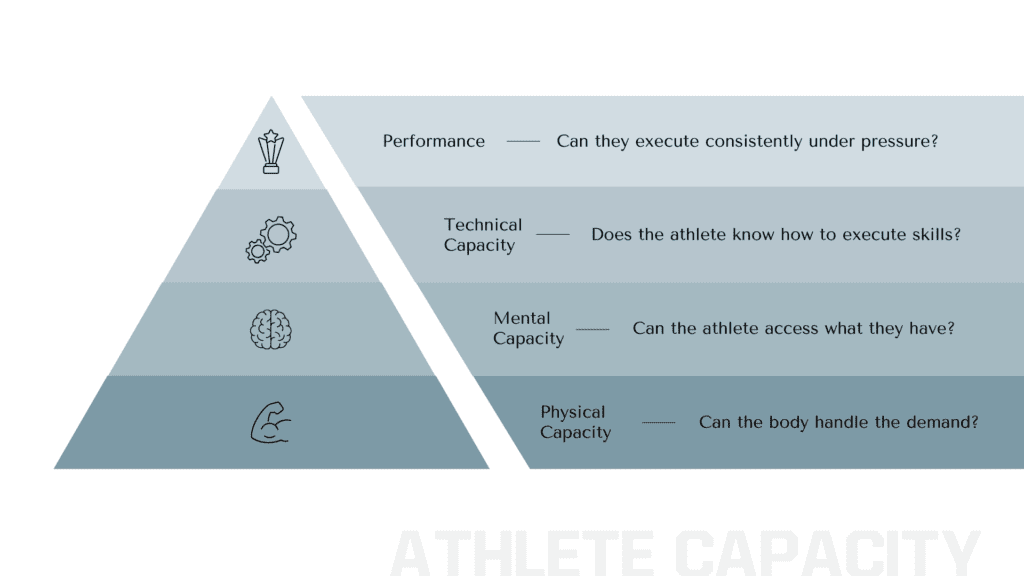
Build bottom-up. Troubleshoot top-down. Let’s break it down.
01. Physical Capacity: The Foundation You Cannot Skip
Physical capacity is non-negotiable. It’s the base of the entire pyramid, and it’s the part of training that gets ignored more than any other in cheerleading. We’re talking about strength, stability, mobility, and work capacity. Your body’s actual ability to handle the demand of the skills you want to throw.
You cannot out-skill lack of physical capacity. Period. There is no version of this where you skip the physical work and still hit elite-level stunting, tumbling, baskets, or pyramids consistently. The demand of the skill exceeds what your body can produce, and either the skill doesn’t land or your body breaks down trying.
When athletes come into the sport, the focus is almost always on skills. I want to learn this stunt. How do I do that tumbling skill? I want to get a full. Meanwhile, the physical foundation underneath them isn’t ready to support what they’re attempting. So how do you build it? Exercise and nutrition. I know nobody wants to hear it. Coaches are tired of saying it and athletes are tired of hearing it. But the answer doesn’t change just because it’s not exciting. Get in the gym. Eat to fuel your body. Build your work capacity. Then everything above it gets easier.
02. Mental Capacity: The Gatekeeper to Your Skills
Sitting on top of physical capacity is mental capacity, and I call this one the gatekeeper. Here’s why. You can have all the physical ability in the world, but if your brain doesn’t believe you can do the skill, you can’t access what your body is capable of. Mental capacity is what unlocks the door to your physical ability.
There’s a story I love about this. Roger Bannister. For decades, the four-minute mile was considered physiologically impossible. People literally believed your heart would explode trying to sustain that pace. Then in 1954, Bannister ran a sub-four-minute mile, and the entire scientific community had to reconsider what was actually possible. The wild part? Once it had been done once, other runners started breaking it too. Not because human physiology suddenly evolved, but because the mental barrier was gone.
That’s mental capacity. It’s emotional regulation. Productive self-talk. Executing under pressure when the routine is running and the gym is loud. It’s regulating your attention and staying focused on the task in front of you instead of spiraling about the last fall or the next skill. The question to ask yourself isn’t just “do I have it physically?” It’s “do I have access to it?”
Building mental capacity isn’t mystical. Structure your training. Routine your week. Simulate the pressure scenarios in practice so they don’t feel foreign at competition. The mental load of decision fatigue is real, and giving yourself structure preserves the mental energy you need for the moments that count.
Technical Capacity: Where Most Athletes Skip Steps
Technical capacity is where the actual skill work lives, and it sits on top of physical and mental. This is where I see the most coaching mistakes happen, and it’s also where the most athlete frustration shows up. The instinct from both sides is to jump straight to refinement. Tell me exactly what to do. Give me the technical correction. And that’s not where the learning actually starts.
Technical capacity has its own sequence underneath it. First, capacity. Can the athlete physically and mentally do this? Then perception. Do they understand the task or the problem they’re trying to solve? Then constraints. Set the parameters. Hands down on one. Feet down on two. Reach for the rafters. Don’t release the skill early. Constraints give the body a framework to operate inside of without overloading the brain with technical detail.
After constraints comes exploration. This is where you let the athlete actually try it. Trial and error. Their body starts intuitively figuring out what works and what doesn’t, and that’s how real adjustments get made in real time. Skills are never identical. Weight shifts back. The flyer stands faster. The floor punches differently. The athletes who can adjust mid-skill are the ones who explored enough to develop that intuition.
Then comes simple guidance. Not technical jargon. Not a breakdown of every grip and angle. Just a clear correction: “Stand up on two, not three.” Got it. Once the athlete is operating with simple guidance and the skill is becoming muscle memory, that’s when refinement enters the picture. That’s when specific technical corrections actually land, because the body already knows the foundation of what it’s doing.
If you skip ahead to refinement before exploration has happened, you overload the athlete, kill their intuition, and burn them out on the skill. Don’t do it.
Performance Is the Outcome, Not the Goal
Performance sits at the top of the pyramid, but here’s the thing. You don’t coach performance. You don’t train performance. Performance is the lagging indicator of everything underneath it. It’s the result of physical, mental, and technical capacity all being in alignment.
So when performance is off, you don’t fix it by just trying harder at the performance level. You troubleshoot top-down. Is it technical? Where in the technical chain did it break? Are you being too overly technical and losing intuition? Did you not explore enough? If technical isn’t the issue, drop down. Is it mental? Are you blocked from accessing what you can physically do? If that checks out, drop down again. Is the physical capacity actually there to support the demand?
Build bottom-up. Troubleshoot top-down. When the foundation is solid and every layer is supporting the one above it, performance takes care of itself. That’s the whole point.
If you feel stuck right now, don’t add more reps. Pause and ask what you’re building on. There’s a really good chance the foundation is the problem, and no amount of effort at the top of the pyramid is going to fix something that’s broken at the base.
Listen to the Full Episode
If you want the full breakdown of the athlete capacity pyramid, listen to this week’s episode of Bonde on Cheer HERE.
Resources to help you progress as a Cheerleader:
And if you’re ready to start building real technical capacity and need some guidance, that’s what we’re here for!
Need guidance on how to increase your physical capacity? 👉 Get Bonde’s Free 12-Week Workout Plan for Cheerleaders 🥇: https://hybridcheer.com/12-week-workout
Need help on the technical side of stunts? 👉 The Hybrid Library: https://hybridcheer.com/library
Get on-demand access to our full library of stunt tutorials, drills, and tips to help you hit harder skills no matter where you are.
Want Bonde to come teach your team how to hit harder skills this season? 👉 Stunt Clinics: https://hybridcheer.com/events
Bring Hybrid to your program for an in-depth clinic focused on the skills your team needs to progress.


Show Comments