


Every stunt and every tumbling skill can be broken down into 5 main elements: what I call the Big 5. If a cheer skills aren’t hitting or a skill isn’t landing, then one of these 5 elements is breaking down.
The Big 5 is a method that we have developed to help simplify coaching or at least provide some sort of map so it isn’t this crazy throwing stuff at the wall to see what sticks kind of approach that just leaves athletes burnt out, coaches burnt out, and everybody frustrated.
The Big 5 of Cheer Skills:
Shapes
Speed
Timing
Pressure
and Placement.
Not in any particular order.
The Big 5 is simply putting language to cheer skills so that athletes can understand where a skill is breaking down. A great coach is somebody that can help figure out why a skill isn’t working, identify where the breakdown is happening, then communicate to an athlete how to apply corrections and drills.
How the Big 5 show up in Cheer Skills:
Every stunt and every tumbling skill breaks down along five elements: shapes, speed, pressure, timing, and placement. When something is not working, it is one of these five.
Shapes
Shapes are the body positions an athlete creates throughout a skill. Bases have shapes. Flyers have shapes. Tumblers are essentially just throwing their body into a sequence of shapes at specific moments. A cupie line is a shape. A tight body position in a rewind is a shape. Shapes can be coached through spotting, drilling, and repetition, and they translate directly between tumbling and stunting at the elite level.
Speed
Speed is the rate of movement. A slow full-up and a fast full-up can look completely different even if every other element is identical. Speed is tied directly to power, the ability to move mass in a given period of time, which is why physical development matters so much in this sport. When skills are consistently low or underpowered, speed is usually where the breakdown starts.
Pressure
Pressure is where force is being applied. Tumbling on the heels instead of the balls of the feet is a pressure issue. A stunt that drifts forward because a base is not driving straight up is a pressure issue. Newton’s third law plays out in real time every time a stunt leaves the ground, so incorrect pressure does not just create one problem. It creates an equal and opposite reaction that compounds everything else.
Placement
Placement is where feet, hips, and hands are positioned in relation to the rest of the body or group. Placement is often confused with shapes, but they are distinct. A flyer can have a perfect handstand shape in a front handspring up and still place her hands too far from the group, which kills the stunt before it starts. Placement is about spatial relationship. Shapes are about body position. Both matter, and they are not the same thing.
Timing
Timing is the collective synchronization of a skill. A slow stunt with perfect timing is still a slow stunt, but the timing is not the problem. The speed is. Timing refers to whether athletes are moving together, whether the moment of takeoff and catch and release are aligned. You can have good timing and still have a speed problem. Separating those two is important for an accurate diagnosis.
How to Use the Big 5 to Actually Diagnose a Skill
Knowing the Big 5 is only useful if you can apply it in real time. The process is straightforward: when a skill is not hitting, identify which of the five elements is breaking down, then ask why.
That why question is where the athlete capacity pyramid comes in. Every breakdown in the Big 5 has a root cause in one of three places: technical capacity, meaning the athlete does not know what to do; mental capacity, meaning the athlete knows but cannot access it under pressure; or physical capacity, meaning the athlete understands and wants to apply it but does not have the strength or conditioning to execute.
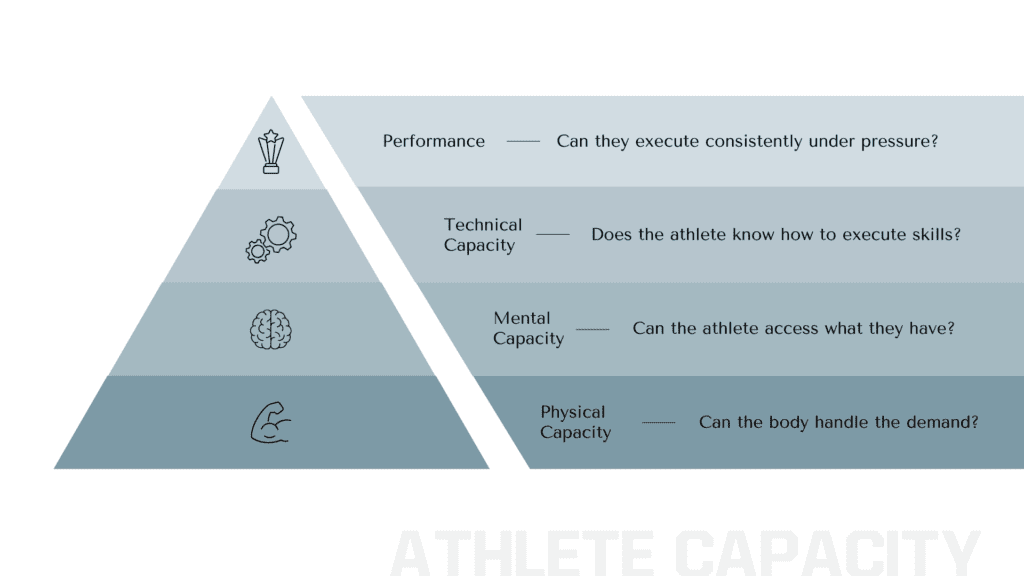
Cheerleading leans heavily on technical instruction and almost ignores physical capacity. That creates coaches who spend hours explaining corrections that an athlete cannot physically apply because they are not strong enough. If pressure is consistently breaking down across multiple athletes, zoom out before you start rephrasing the correction. The answer might be in the weight room, not on the mat.
RELATED: Learn the Athlete Capacity Pyramid and how it directly relates to cheer performance >>
The 3 Attempt Rule
The most common coaching mistake I see, regardless of level, is giving too many corrections too quickly.
An athlete misses a skill, the coach gives a correction. Athlete goes again, misses. Coach gives a different correction. Athlete tries a third time, misses. Different correction. By the third or fourth attempt, the athlete has five things running through their head simultaneously and no idea which one actually matters.
Over-coaching creates mental blocks because athletes stop being able to trust their body. Now they are thinking about a list of things that could go wrong, and that hesitation is its own obstacle.
That is why we use what I call the 3 Attempt Rule: Give an athlete a correction, and let them attempt the skill three times.
If nothing changes, either rephrase the correction or introduce a drill. Rephrasing solves an understanding problem because sometimes the cheerleader didn’t understand the correction you gave. Drills solve an application problem for when the athlete does understand your correction, but can’t physically apply it during the skill.
The 3 Attempt Rule creates breathing room for athletes to understand, explore a skill, coaches to slow down and effectively coach a skill. Once you know what is breaking down and why, you can coach with precision. One correction. Three attempts. Then either rephrase or drill based on whether the problem is understanding or application.
What Happens When You Coach Cheer Skills This Way
Athletes stop accumulating mental blocks because you stop overloading them. Coaches stop guessing because they have a framework to work from. Frustration on both sides drops because the process is systematic instead of reactive.
The goal is not to have a perfect answer every time. The goal is to have a method that helps you find the answer faster and communicate it more effectively. The Big 5 and the 3 Attempt Rule give you that. Combine them with an honest assessment of where an athlete’s capacity is actually breaking down, and you have a coaching approach that produces results and protects athletes along the way.


Show Comments