


If you’ve ever watched an athlete nail a skill in practice all week only to fall apart at competition, you already know the frustration. Cheerleading consistency tips are everywhere — breathe, visualize, trust your training — but most of them miss the real problem.
Consistency under pressure doesn’t start in the athlete’s head. It starts in the foundation that was or wasn’t built long before the pressure ever showed up. Whether you’re a coach trying to understand why your team unravels in the final weeks of the season, or an athlete wondering why your body forgets everything it knows on the mat, this comes down to one thing: the foundation.
Foundations
No foundation means a high risk of falling apart — literally and figuratively. Physically and mentally.
One thing that doesn’t receive enough time and attention is how much work should go into the prep work — the requisites.
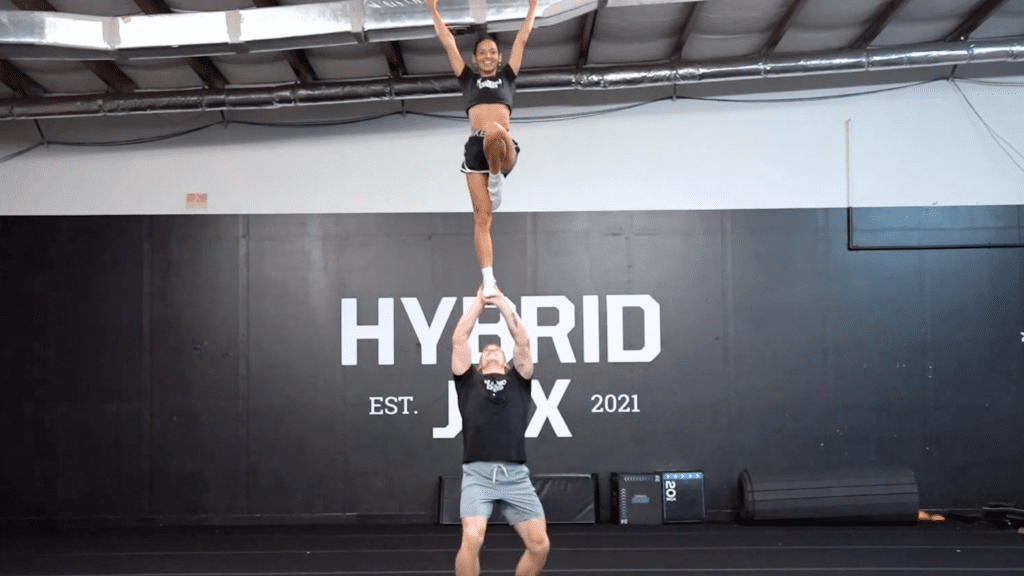
Take partner stunting. The most undervalued skill in partner stunting is the toss. The toss is a skill in itself. A very important one. Yet we often think of skills only in terms of the whole: a tuck, a full-up, a round-off handspring full. But each of those “named” skills is simply a collection of smaller skills working together.
Consistency — especially under pressure — starts with the pieces.
Brick by Brick
So how do we build a solid foundation? Brick by brick. Or in our case, in cheerleading: skill by skill, element by element.
Let’s use a standing tuck as an example — because the standing tuck continues to be a point of contention for many cheerleaders.
If an athlete says: “Hey coach, I want to learn a standing tuck.” As a coach, I’m immediately thinking about components, not the tuck itself.
Please, do not just let somebody flip your athlete(s) over to make it look like they’re learning a standing tuck. There’s a little bit more nuance than that.
The Major Phases:
- The set
- The pull
- The shape
- The landing
Now within each of those phases, I’m evaluating specific elements.
The Set
- Triple extension
- Head position
- Arm path and timing
- Hip drive
- Ankle position
- Speed
- Consistency
The Pull
- Toe, shin, and knee drive
- Timing between arms and lower half
- Torso position
- Core strength
- Shoulder flexibility
The Shape
- Starting posture
- Loading position (ankles, knees, hips, shoulders, head)
- Tuck shape
- Core control
The Landing
- Air awareness
- Foot position
- Arm position
- Head position
And then I zoom in farther and consider what I call the “big five”: speed, pressure, timing, strength, and flexibility.
Before I even allow an athlete to throw a standing tuck, I want them to conceptually understand what they are trying to do. This builds the ability to self-diagnose and self-correct later — which becomes critical at higher levels and is a highly sought after trait in an athlete.
Pause for a second and recognize something: what I just outlined in two minutes is essentially the skeleton of a kinesiology course. And we’re trying to teach this to athletes — some as young as eight. That’s what makes coaching difficult. At least coaching well for long-term development.
Why Skills Break Under Pressure
Here’s where this ties directly into consistency under pressure.
We often see skills break down not because athletes “lost confidence,” but because the foundation was never fully built.
Premature success and an out-weighted element are two of the biggest culprits.
An athlete lands a tuck once. Maybe twice. Everything happened to align that day. Boxes were accidentally checked. But that does not mean the skill has been acquired. Acquisition requires repeatable control of each component.
Second, if an athlete has speed that’s through the roof, then that can make up for a different element we’re deficient in. However, take that speed away because of fatigue or diminish another element like timing, and now we can’t do the skill because our speed alone is no longer enough to offset the deficiency.
Without understanding how the skill is executed, athletes have no roadmap when something goes wrong. And pressure exposes exactly that.
Pressure doesn’t create weakness. It reveals it.
Those small unchecked elements — the set angle, the timing of the pull, the shape in the air — are the first things to unravel when cognitive load increases.
This isn’t unique to a tuck. It applies to stunts, pyramids, tumbling passes, baskets — everything.
Actionable Takeaways
For Coaches:
- Break skills into teachable components before chasing full execution.
- Require repeatable mastery of elements before progressing.
- Simulate pressure only after the foundation is stable.
- Use checklists to identify breakdown points rather than labeling athletes “inconsistent.”
For Athletes:
- Learn the “why” behind each movement.
- Ask which component needs work when something goes wrong.
- Chase repetition of correct mechanics, not occasional success.
- Understand that landing it once is not the same as owning the skill.
Final Thoughts
When building skills, think of them as combinations of smaller skills wrapped into one.
If you take the time to coach each element individually, two things happen: the skill becomes easier to build, and the confidence within that skill becomes durable.
Durable confidence leads to durable consistency.
And durable consistency is what survives pressure.
Because when the foundation is solid, pressure has nothing to expose.


Show Comments