


If you’re counting down the days to tryouts and wondering what to work on, here is the truth about cheer tryout prep that most athletes never hear: the goal is not to show up with one impressive skill. The goal is to show up confident, consistent, and physically prepared to operate under pressure. That means the way you train matters just as much as what you train. This episode of Bonde on Cheer breaks down exactly how to get ready for cheer tryouts like a serious athlete.
YouTube | Apple Podcasts | Spotify
The Mental Component Is the One That Will Trip You Up
The hardest part of tryout season is not the physical component. Yes, both exist. There is a big mental component and a big physical component, but the mental component is the one we need to make sure we’re focused on enough because that is the one that will trip us up.
Confidence is not just hype and ego. Confidence is knowing you own the skills you’re throwing at tryouts. Not hoping, not wishing, not praying on it. Owning them. A lot of people say they get nervous at tryouts, and I want to reframe what that actually means.
If you are nervous, it is typically not that you are bad under pressure. It typically means you do not have enough experience throwing the skills you plan to perform. The solution is quality reps and, in some cases, choosing better skills to throw.
On tryout day, the spotlight is already bright. We do not need to add anything to that by attempting a skill that sits just outside our confidence zone.
Strength and Conditioning Comes First
Many of you are going to hate me when I say this, but one of the first things you should focus on in tryout prep is strength and conditioning. And before your eyes glaze over, let me actually explain what that should look like.
Three days a week. That is it. Not seven, not five. Three.
A lot of people go wrong by deciding they need to be in the gym every day, realizing they cannot sustain that, and then doing nothing at all. Do not scare yourself out of something that would genuinely help you just three days a week.
Workout Day 1: Push
Day one is your push day. The anchor movements are bench press for upper body and back squat for lower body.
Everything else on this day is accessory work built around those two compound movements. As cheerleaders, we need overhead strength, but we want to prioritize chest, shoulders, triceps, core, lats, and legs all together.
Bench press and squat accomplish that better than anything else.
Workout Day 2: Pull
Day two is your pull day. Deadlift and pull-ups. Lower body, deadlift. Upper body, pull-ups.
Pulling strength is essential for posture, overhead position, and posterior chain stability. All of that gets used when you stunt, when you tumble, and when you are trying to stay healthy throughout a long season.
If a barbell deadlift feels intimidating right now, that is fine. Use a band for pull-ups, do dumbbell RDLs, or work with kettlebell deadlifts. Scale to where you are and build from there.
Workout Day 3: Conditioning Circuit
Day three is conditioning. This day builds aerobic capacity and muscular endurance so that your body can actually function during full outs.
You know that feeling when the coach says you are running it again and everyone quietly dies inside?
Conditioning is how you stop dreading that moment.
You do not need a PhD in exercise physiology to benefit from it. You just need to do it consistently so that your body gets better at clearing out lactic acid and recovering between reps.
Free Challenge: Take the Guesswork out of Working Out
We know that strength and conditioning can feel daunting. Especially if you have little to no experience in a workout gym.
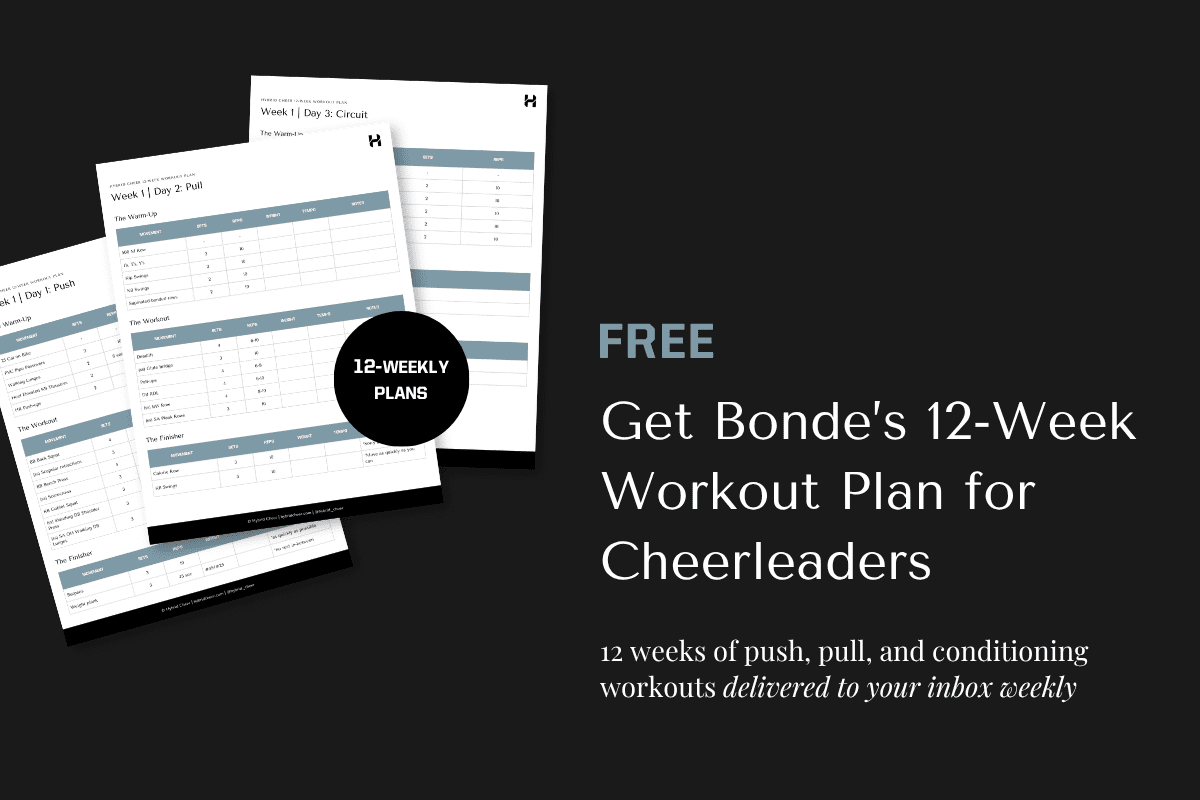
We’ve taken the guesswork out of working out for you with our Free 12-Week Program built around Bonde’s 3-day push, pull, and conditioning weekly workout plan for cheerleaders.
When you fill out the form HERE and subscribe to our newsletter, you’ll get a step-by-step strength and conditioning plan perfect for any level athlete. Each week, you’ll get a printable PDF delivered to your inbox so you don’t have to guess what to do in the gym along with movement clips to show you what each exercise should look like.
Three days a week, laid out for you.
By the end of this 12-week strength challenge, you’ll be a stronger teammate, have more stamina for full outs, be less prone to injury, and have the conditioning you need to hit harder stunts and execute better tumbling passes. 👏
Two Days of Cheer-Specific Training Each Week
On top of the three strength and conditioning days, we want two cheer-specific training days per week.
Cheer Day 1: Tumbling
The biggest mistake I see athletes make during cheer tryout prep is coming in and doing nothing but their hardest tumbling skill over and over until they are completely gassed.
Here is what I want you to do on tumbling day instead.
Start every session with a dynamic warmup.
Then move into handstands, handstand walks, and handstand pirouettes. That last one throws a lot of athletes off. Handstand pirouettes teach your body how to spin while upside down. Toes over hips, hips over shoulders, shoulders over hands. You are training your nervous system to understand rotation before you ever add the flip.
Even if you do not have a tuck yet, you can work these and you will absolutely benefit from them.
After that, work through your cartwheel snap down rebounds, handstand blocks, roundoffs, and then build progressively through roundoff back handspring to your current skill level.
If you have a roundoff handspring tuck, you build up to the tuck. If you stop at one handspring, you stop there. The point is that you are consistently reinforcing the foundation before you start working past it.
Only after you have done all of that do you move into working the skill above your current level.
A Hard Truth About Throwing Hard Skills at Tryouts
Before you decide what to throw at tryouts, ask yourself these questions:
- Can you throw this skill three times in a row cleanly?
- Could you throw it in a routine?
- Could you do it in multiple full outs back to back when you are tired?
- Could you do it when something is off, whether that is stress, poor sleep, or physical fatigue?
If the honest answer is no, then do not throw it at tryouts. Regression is not failure.
If you have been working a full but cannot confidently answer yes to those questions, throw a layout. If the layout is shaky, throw a tuck. Work your way back to the skill that you own completely, and throw that one.
If you are desperate to let a coach know that you are working a harder skill, send them videos. Throw it on a rod floor, throw it with a spot, and send that footage to the team chat or directly to the coach. That is not ego. That is leadership. It shows that you are working outside of practice, invested in the team, and close to something real. Showing up to tryouts and gambling on a skill you cannot replicate does none of that.
Cheer Day 2: Stunting
Stunting Prep Follows the Same Logic
For your stunting days, half the session needs to be basics. Always.
That means preps or hands for coed, extensions, libs, stretches, opposites, opposite libs, opposite stretches, power presses, tick tocks, full ups, full rounds, and quick tosses for groups.
All of these build the foundation: flyer body position, flexibility, speed, grip control, hip control, and line control from every person in the group.
On timing and counts, here is a universal framework that applies to nearly every skill outside of power presses and hand in hand variations.
Shrug on one, grab on three, dip on five, up on six, and hit on seven.
That is the pace we are looking for.
Dip, throw, catch. Back to back, clean and fast. Most cheerleaders move too slowly, and this applies across skill levels. Get your groups used to hitting that tempo.
After your basics and counts work, move into progressions with a spotter. Three reps on each progression. If you are hitting, move forward.
If not, move to a different skill and come back next session. Do not sit there and throw twenty reps of something that is not working. You will spiral into what I call the pit of despair, and it is very hard to climb back out. Document what is hitting and what is not, and let the progression unfold at its own pace. Rushing those steps will crack the foundation and cause bigger problems later in the season.
The entire warm up, counts, and progression block should take twenty minutes. Get in, move with a purpose, take small water breaks when you hit milestones, and then get to work.
Train to Operate, Not to Highlight
Big picture, if you go into tryout season prep focused on one flashy sequence or one difficult tumbling pass, that is short-term thinking.
You are not training for a highlight. You are not training for a one-off, look at what I can do moment. You are training to operate consistently under fatigue, under pressure, and with variables, like tumbling in a line next to other people with forty-two feet of runway instead of eighty-four.
That gap between what you can do alone in an open gym and what you can do in a tryout setting is what your preparation needs to close.
All athletes start in different places. The approach, though, should never change. Structured, methodical, progression-based.
Think of it like the tortoise and the hare. The hare is talented, fast, and full of short-term thinking. The tortoise is focused, consistent, and not going to be distracted by the urgency of trying to impress someone on a single day. The tortoise makes the team and survives the season. The hare might make the team. The hare is probably not going to survive it.
Be the tortoise. Good luck out there.


Show Comments