


Summer is where your fall season actually gets built, but getting all your cheerleaders in together outside of camp can be tough! Between family vacations, work schedules, and athletes traveling in every direction, getting your whole team in the gym at the same time becomes nearly impossible from June through August. So progress stalls by default, not by choice, and you end up spending the first month of the season rebuilding skills your athletes had locked in back in May. A structured summer cheer challenge solves that.
It keeps every athlete progressing on the exact skills your scoresheet rewards, on their own schedule, even when you cannot get them all in one room. If you have never run one before, I’m breaking down how to put one together here.
Start With Your Cheer Routine Scoresheet, Not a Random Task List
Before you build a task list, evaluate your team honestly against the scoresheet you will be judged on this Fall. And review where your weak points were brought to light at your end of season events last year.
Where are the gaps? What easy points did you lose out on last season? A good summer challenge attacks your weak spots on purpose.
Maybe your standing tumbling numbers are low. Or jumps might be costing you execution points you cannot afford to give away. Pinpoint the specific skills your team needs to be consistent on by the time fall season starts, then build your summer cheer challenge tasks directly around those.
Plan Workout Load Around Your Practice Schedule
The summer season is a great time to incorporate weightlifting into your team’s conditioning plan.
Before you assign workouts, look at how often your team is actually together this summer. If you are running multiple stunt practices a week, you can’t also pile on heavy lifting and expect quality out of either one.
We recommend capping it at two heavy lift days and two stunt practice days in a given week. A third training day is fine if it is circuit based with lighter weight. When athletes are doing a third circuit during a week they are also practicing, have them save it for after practice rather than before, and keep it to around thirty minutes. The point of the weight training in cheerleading is building physical capacity, not burying your athletes under so much volume that their stunt sessions suffer for it.
Related Post: Breaking down the Athlete Capacity Pyramid and how to help your cheerleaders train to hit harder skills >>
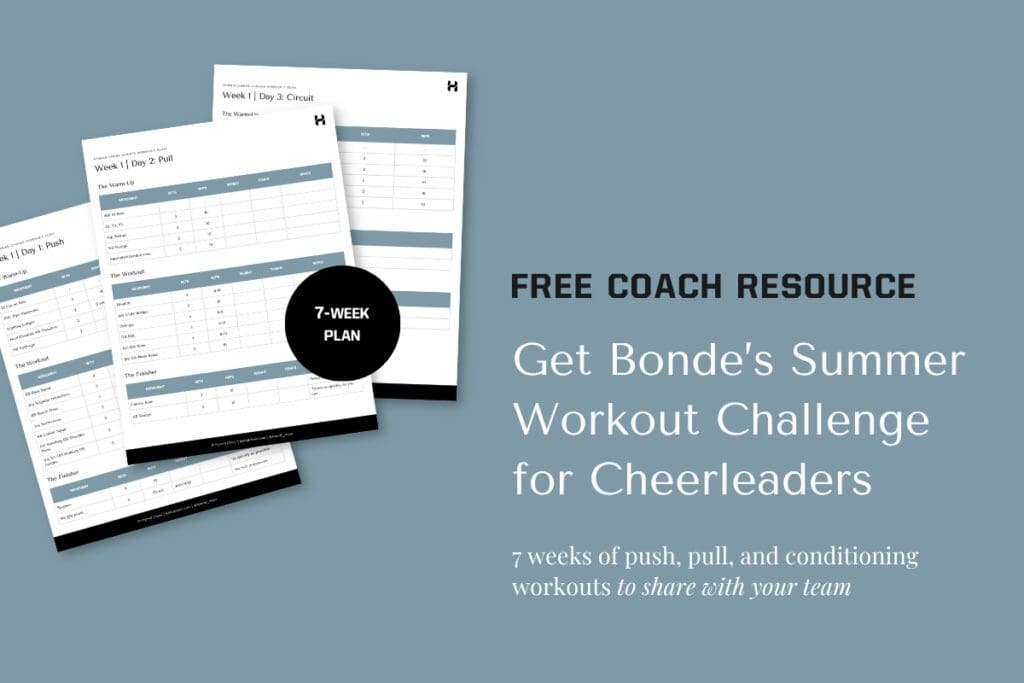
Need some guidance on where to start with building strength and conditioning into your team’s summer plans? Grab our Free Summer Workout Challenge guide for coaches. We’ve put together a 7-week plan you can send to your athletes complete with videos of all workout moves so they know how to complete them. You can break the workout challenge apart any way you want!
Get the Free Summer Workout Challenge plan for cheer coaches HERE >>
Add a Stunt Component If Your Team Is Apart
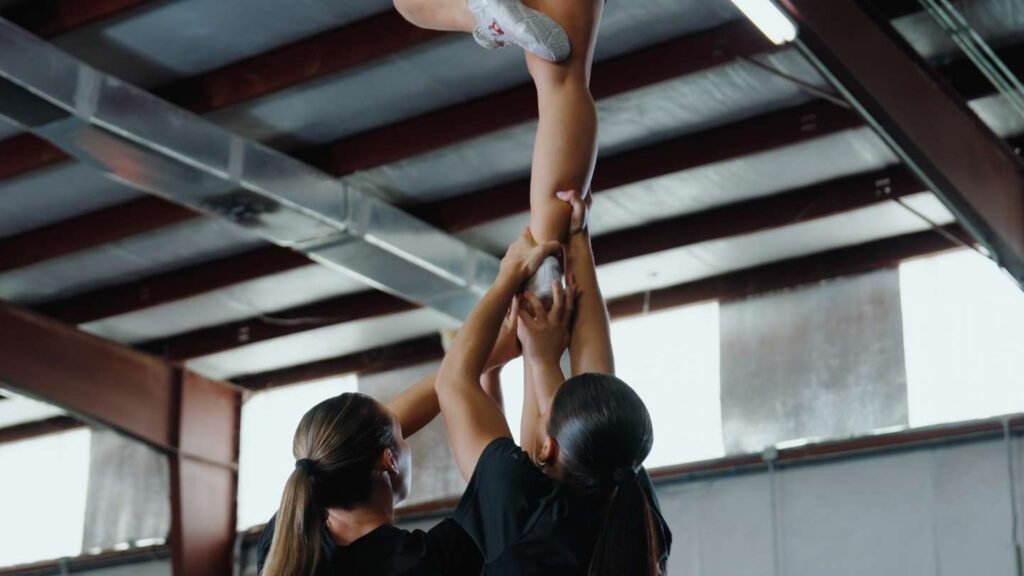
Plenty of teams scatter over the summer and barely see each other until August. If that is your situation, consider adding a stunt component into your summer cheer challenge. Assign each stunt group a sequence and a hard deadline, then make them organize on their own to get together and submit video proof of hitting it a certain number of times. This keeps stunt groups communicating and working together over the break, and it forces the kind of accountability that shows who is willing to put in the work to hit.
Pick Your Summer Cheer Challenge Categories
Here are five categories and ideas to include in your summer challenge. Use all of them or choose the few that target your team’s specific weak spots.
- Strength and Conditioning: Decide how many days a week you want your athletes lifting and plan the workouts. If you’d rather not program it yourself, use our free Summer Workout Challenge you can send straight to your team. It runs three days a week through push, pull, and circuit work designed specifically for cheerleaders, with video clips of every movement so athletes who have never set foot in a weight room are not left guessing.
- Jumps: Determine what jumps you will most likely work into your Fall routine choreography and work them into your weekly challenge tasks.
- Standing Tumbling: Each athlete films three standing tucks in a row on a dead mat. If they do not have a tuck, substitute a back handspring. For athletes who do not tumble yet, give them an alternate target like an extra jump set so nobody is left out.
- Running Tumbling: Each athlete films their highest running pass three times in a row.
- Stunts: Set a sequence, give groups a deadline, and require three clean hit videos of the full sequence.
Make It Mandatory, Not a Suggestion
Give your summer cheer challenge a clear start and end date. Every task needs a deadline and a simple way to submit proof.
Track completion somewhere visible so athletes can see who is checking boxes and who is falling behind. If you have a communication app like Band, create an album for your athletes to turn in Summer Cheer Challenge work that way everyone can see each other’s progress for accountability.
Build in stakes that fit your team culture, whether that is a leaderboard or a reward for anyone who finishes the challenge.
Example Summer Cheer Challenge with 4 Categories:
Week 1 – Due Sunday, July 5th
Workouts
- Complete Week 1 Day 1 Push Workout
- Complete Week 1 Day 2 Pull Workout
- Complete Week 1 Day 3 Workout
Jumps
- Film yourself doing 3 double jumps in a row – Right hurdler, Toe touch
Standing Tumbling
- Film yourself landing 3 standing tucks in a row on dead mat.
Stunts
- Coordinate with your group to get together and stunt this week. Your goal is to submit a video of you successfully hitting 3 Full Up Switch Ups in a row.
Make it Challenging, but Be Realistic
It probably isn’t realistic to have a stunt challenge every week or to expect your athletes to be able to do a full 9-10 week challenge over the summer. You want to set your kids up for success here. Maybe choose 1 stunt challenge every 3 weeks or per summer month to make sure there is plenty of time for the stunt group to find a pocket of time they can get together.
The reason our Summer Workout Challenge is only a 7-week guide is because we know most teams have at least a camp or stunt clinic over the summer as well as various family vacations. In a week that an intense amount of stunts and lifting is happening like at a summer cheer camp, it isn’t likely that you will be able to also fit in team workouts. We also know it can be very difficult to coordinate workouts, tumbling, or completing other category skills in a week where an athlete is traveling.
To keep it realistic when planning an entire summer challenge, bake in off-weeks for the times you will see the team and self-selected off-weeks for the athletes. If your due dates are weekly, allow your athletes to choose 1-2 weeks of the summer where they self-choose to be off for their vacations and summer plans.
Where to Start
You don’t have to build the strength piece from scratch. Our free Summer Workout Challenge lays out seven weeks of push, pull, and circuit workouts ready to send to your team, with video clips for every movement. Use it as the conditioning backbone of your challenge, then build your skill categories around it.


Show Comments